

I go on about political economy a lot and I think it is time that I explained what this is and why it matters.
What does political economy do to our lives?
You might be rather surprised to find out.
I will ask you to think a bit and then will explain how our political economy:
Produces social breakdown
Makes people helpless and dependent
…and why we have a chance to change it (for a change)
It should take you about 10 minutes to read.
Thought Experiment
Imagine that we do not live in a system which “evolved” out of the enlightened tolerance of all points of view.
What if liberal democracy isn’t the product of the best ideas winning the debate?
What if it is a system produced by an economic vision for the whole world?
CONTENTS
What is explanatory power?
Creating a Globally Standard World
Where our politics and values come from
PAYWALL
How Political Economy shapes you
Learned Helplessness - A Parable from My Garden
How our political economy makes lifelong dependents of us all
What is The Economy for?
Explanatory Power
Nothing makes sense these days and so ideas which help us to make sense of everything would be very useful indeed.
One way to test the value of ideas is to see how much they explain.
How complete are those explanations? Can we make more sense of things with an idea than without it?
Try this idea out to see if it satisfies this method.
Standardising the world
Imagine that some people came up with the idea of turning the whole world into one thing, everywhere.
You would have to equalise the population, their history, culture, traditions, moral beliefs and religion for starters, but if you succeeded you would have a Standard Global System.
I think this is the basis of the political economy of liberal democracy.
I think if we imagine the goal of this system was to produce a single world economy then all the attempts to install a worldwide monoculture to replace the ones we had make sense.
It also makes sense of the political system produced by this economic vision.
Making Belief in the Global Machine
To recap:
First, the economic model
Second, the politics
Third, the values
The economic basis furnishes a politics to serve itself, and the politics creates values to serve itself. As a whole, the liberal system is animated by technique - which is the refinement, over time, of the process of producing a standard result.
So, economics creates the politics which generates values. Taken together, this machine produces belief - in itself. The belief takes place in you1.
The beliefs are placed in you by the mass culture, which mass produces belief in the system which produces the culture. This is how they make belief, and this is how they make you into a component in a machine.
Some of the effects of this at scale are harder to spot than others. Here I will explain how this creates helpless consumers with no self control.
HOW POLITICAL ECONOMY SHAPES YOU
Political Economy is a tedious phrase.
Economists are disputatious and most politicians are absolutely abhorrent. Yet there is treasure underneath the dungheap, and here it is.
Our political economy sees us all as economic units. We are consumers. The best we can do for The Economy is to consume as much as possible, as often as we can. This is why our money is debt, and why debt is relatively freely available.
This is why there is so little sense of duty, civic, moral or otherwise these days. It is because our political economy requires maximum consumption. This requires people who will indulge wants rather than prudently consider needs.
The ideal sort of person in this system is like a perpetual child. People with low impulse control are great, because they will more readily give in to what ever desire is presented to them, and so more money sloshes around.
Sloshing is what we are supposed to do. It doesn’t matter to The Economy what it is you do to make the sloshing slosh. As long as the money-go-round continues, the Line Goes Up and that is all that matters.
We can get sloshed and therefore buy booze, taxis, kebabs and then seek some solace the day after for our shameful doings. These things all cost money, which is basically credit issued by The Money Power, and the more of it going around the better off we are. Or so we are told.
EVERYTHING MUST GO
In reality consumerism consumes us, the consumers - and everything else of value in life. It turns everything into something to be sold. This is called commodification.
In turn, everything then has a sort of notional value in terms of how much of it can be expected to be sold, or how confident someone is that the interest payments can be made on some loan or other.
This is called financialisation, and it is this Money Power which has consumed everything from human life in its production to the conduct of international relations today.
Of course, this system is morally neutral. It is nihilist. It also produces its own sort of amoral values, which you will notice immediately if you ever recommend anyone restrains their odious behaviour for any reason.
Our political economy has replaced duties with consumer rights, which means you can largely indulge yourself without any limit, howsoever you please, and anyone who tries to tell you no is a rotter. This is self destructive on the personal scale and equally destructive on the social scale. Yet social cohesion is not all we have lost in this globally ambitious profit model.
LEARNED HELPLESSNESS - A GARDEN PARABLE
Everything is turned into money. In place of duties, vocations, institutions, durability and and real purpose, we are supplied with goods and services with terms and conditions applying.
We have a knowledge economy in which no one knows anything and in which no one knows how to make or do anything, either. This is great if you are The Economy, but not so great if you are You. Apropos this, a parable from my life.
I was not answering any comments on Saturday as I had mistakenly looked out of the window of late and realised the garden had started to mock me.2 This I could not have, and so I spent the day teaching what we laughingly call the lawn A Lesson.
Halfway through the correction of this verdant upstart the lawnmower became insubordinate.
Black smoke - usually not a Good Sign of anything - belched from its bottom. Being a Consumer my first thought was to chuck it in the bin and go and buy another one. And then I chastised myself - only quietly as I have refined that technique - and took it to bits instead.
Lawnie’s little belt had whipped off and so I cleaned up his gummy spools and put it back on. I screwed him back together and was thrilled to see he worked again - and smokelessly, too.
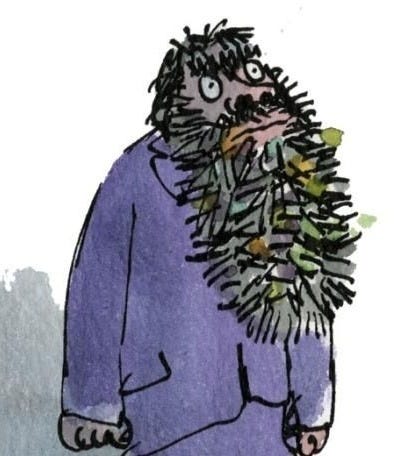
The sense of victory which filled me on seeing him submit to my will was tremendous. I had learned Not To Be A Twit in a significant way. Better still, another sort of Lesson was delivered to the remainder of my unruly lawn.
Had I not elected to suffer in wrangling Lawnie back to work I would have produced more economic sloshing. I would have bought another consumer consumable.
I would have filled up the earth with a bit more trash, but who cares because Line Go Up.
Instead, I learned how to fix Lawnie, and also how not to say swearwords loudly whilst doing so, as my neighbours were pretending not to watch me suffer.
HELPLESS DEPENDENTS
It is better to have people who know little or nothing of practical value because when they need help they will pay for someone - or something - to help them.
This is why helpless people are the optimal people for the consumer economy.
You may consider now why so many adults are tantrum-prone lifelong children, and then consider how these traits are favoured by the political economy.
It supplies therapy, drugs, holidays, leisure activities, cut-price celebrity totems. It never supplies cures, but always more of itself, in every case.
Look again, and you can reframe much of our consumer economy as the clever marketing of some form of dependence. What is “brand loyalty” other than the deliberate forming of habit?
Our political economy creates a dependency culture.
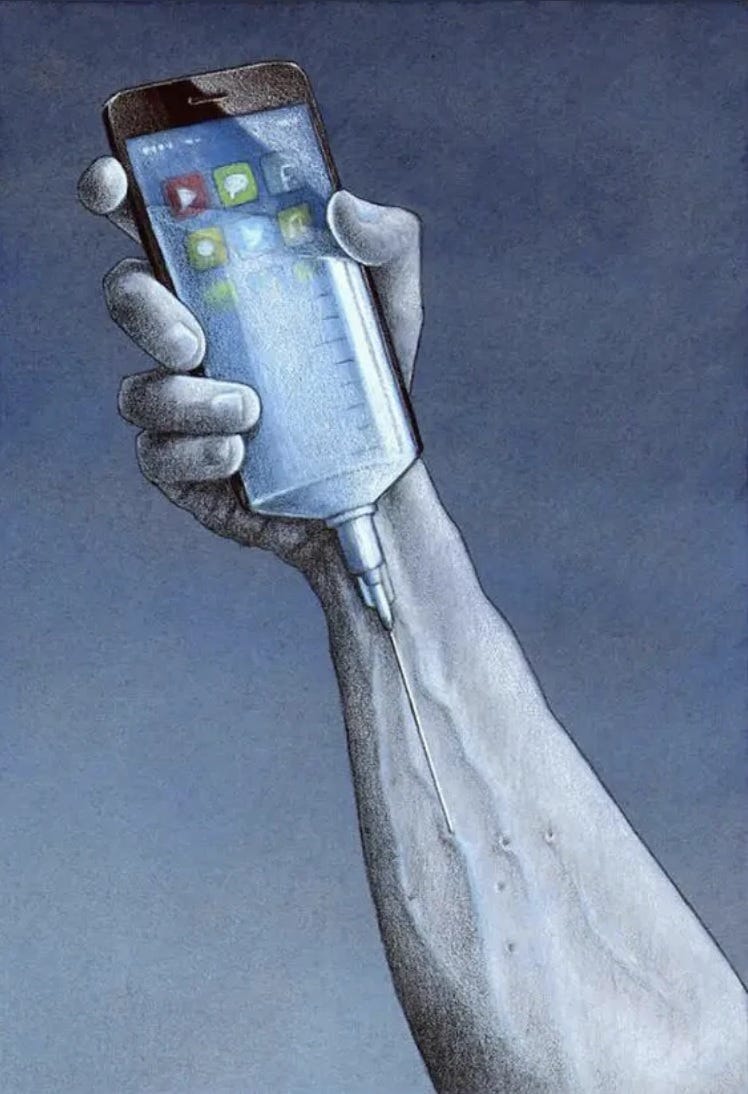
It can be seen as the marketing of addictions as special offers. Some of these offers are material, like sports shoes or soft drinks, some are sensational like sex or gambling, others are conceptual - like lifestyle choices and identity.
These last are often invisible because they have become indivisible from the idea of ourselves.
We come to depend on these things, these habits they form become us, and so we can no longer see what they or we really are.
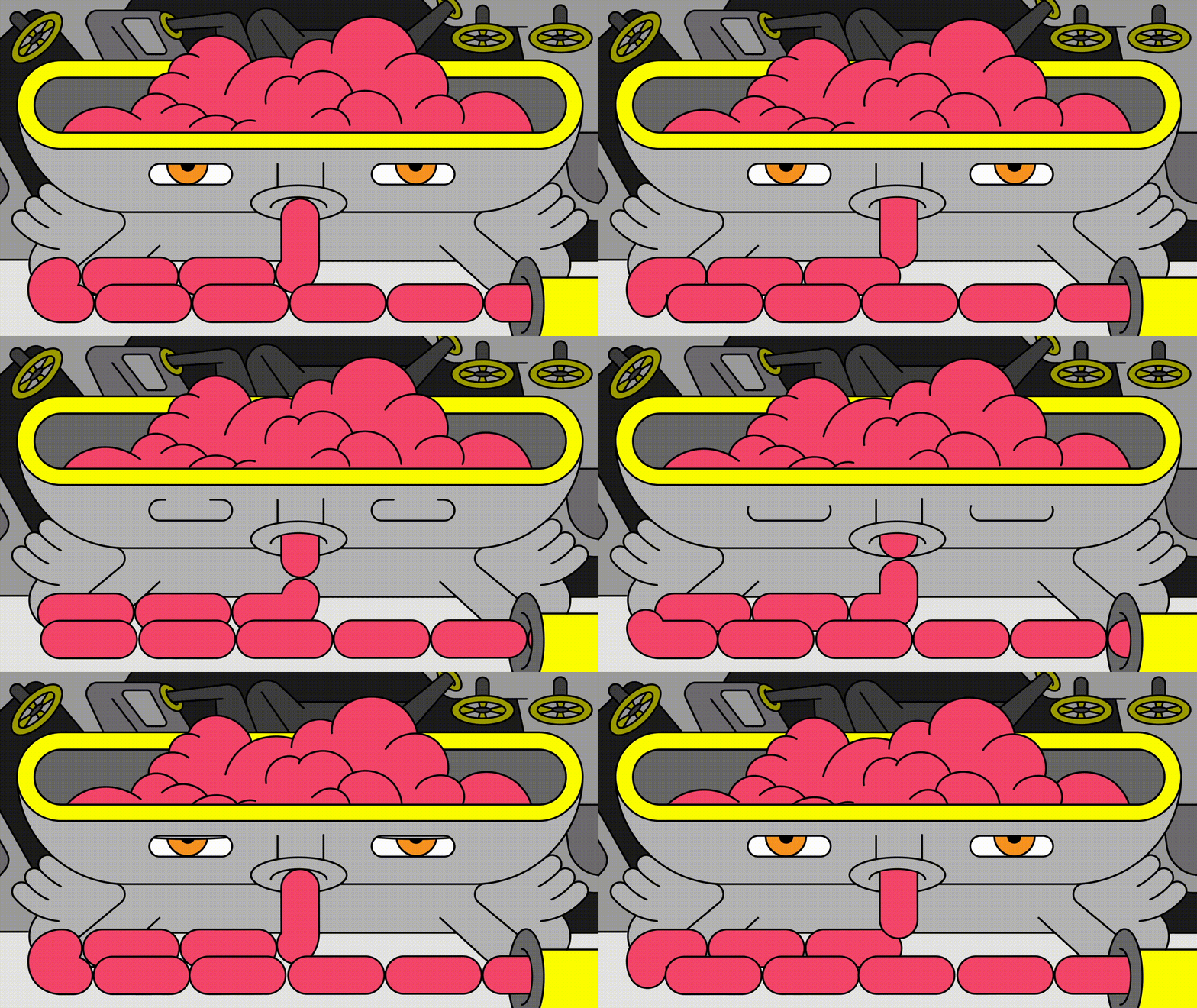
IT’S THE ECONOMY, STUPID
Now you can see how our political economy mass produces people towards its own ends.
We have a consumer economy. It sells products, lifestyles, brands, beliefs to people patterned on the cheap and instant gratification of whatever we think we need, now.
When you realise where these “needs” come from, you realise why you should care about political economy, because these desires make us who we are, toward a given end, and that end is destroying us and the civilisation we naturally prefer to inhabit.
It is not all bad news, however, and especially because of all this talk of the End Times.
What is The Economy for?
In our political economy, we are for The Economy and it is not For Us.
It is possible to have an economy which is for us instead, but that is anathema to the one we are in and so this is probably the first time you have heard anyone say this3.
What is valuable about the crisis created by this mad system is that it cannot go on supplying cheap trash to satisfy the desires created by its belief system - for the purpose of its own profit (and at the general loss of everything else).
This means that we will have the opportunity to ask what the economy is for, and whether we should be for it, or it for us.
That is perhaps the most important reason why you should care about political economy, as you and I will get to have a say for once about whether there should be more to life than this.
I have written about the manufacture of mass belief here, for example.
I am surrounded by very few people but they all have exquisite gardens. Though they say nothing, this only amplifies the SHAMEWAVES, which radiate into my being whenever the garden grows savagely out of hand, which is practically all the time.
Except for when I say enough, and that is when the fun really begins. Of course, the lawnmower waits for this moment in order to torment me, but I am having none of that, and it - like the so-called “lawn”, has been taught a lesson.
Like driving, gardening is about VICTORY.
I did a series on the Catholic Social Teaching of Leo XIII, which has three separate posts on the suggested political economy of the Church (Rerum Novarum).
May 11, 2026
The Academy of Motion Pictures updated its official rules stating that A I generated actors and writers would not be eligible for nominations (this is to the best of my understanding).
I need to clarify what I wrote earlier today regarding A I generated “religious art” where I refer in a derogatory way to the word man, or rather “man hours”. I’m being sarcastic, because of course I love all of mankind and respect the man hours we put into meaning work. But what angers me, and I believe many working humans beings, is the threat that Artificial Intelligence poses to many jobs and professions.
Possessing degrees in art myself, the idea of switching out a traditional looking religious painting with an A I generated one, and offering some reassurance that it’s been “blessed by a priest”, really hit a nerve with me.
I’ve included information regarding how the Academy of Motion Pictures has taken this issue very seriously as well.
I absolutely respect our good exorcists and the idea of online healing and deliverance sessions. But what I’m trying to drive home is that anyone, who considers the human dimension of their work or profession as absolutely safe from A I substitution or infringement, may want to think again. This is having a profound effect on our economic system and our society as a whole. I see legitimate use and purpose for A I. But aren’t there also reasons for alarm?
Remember the movie ‘Full Metal Jacket’ and the ball kicker colonel screamed that inside every Vietnamese was an American waiting to emerge? Well, it’s the same with this system.
Inside every human being according to their usury (financial sorcery) they expect that there is a consumer, just waiting to emerge and taint their souls for mammon.