
Holiday reading: Life Lessons from TS Eliot
How to escape the trap of the modern Liberal condition

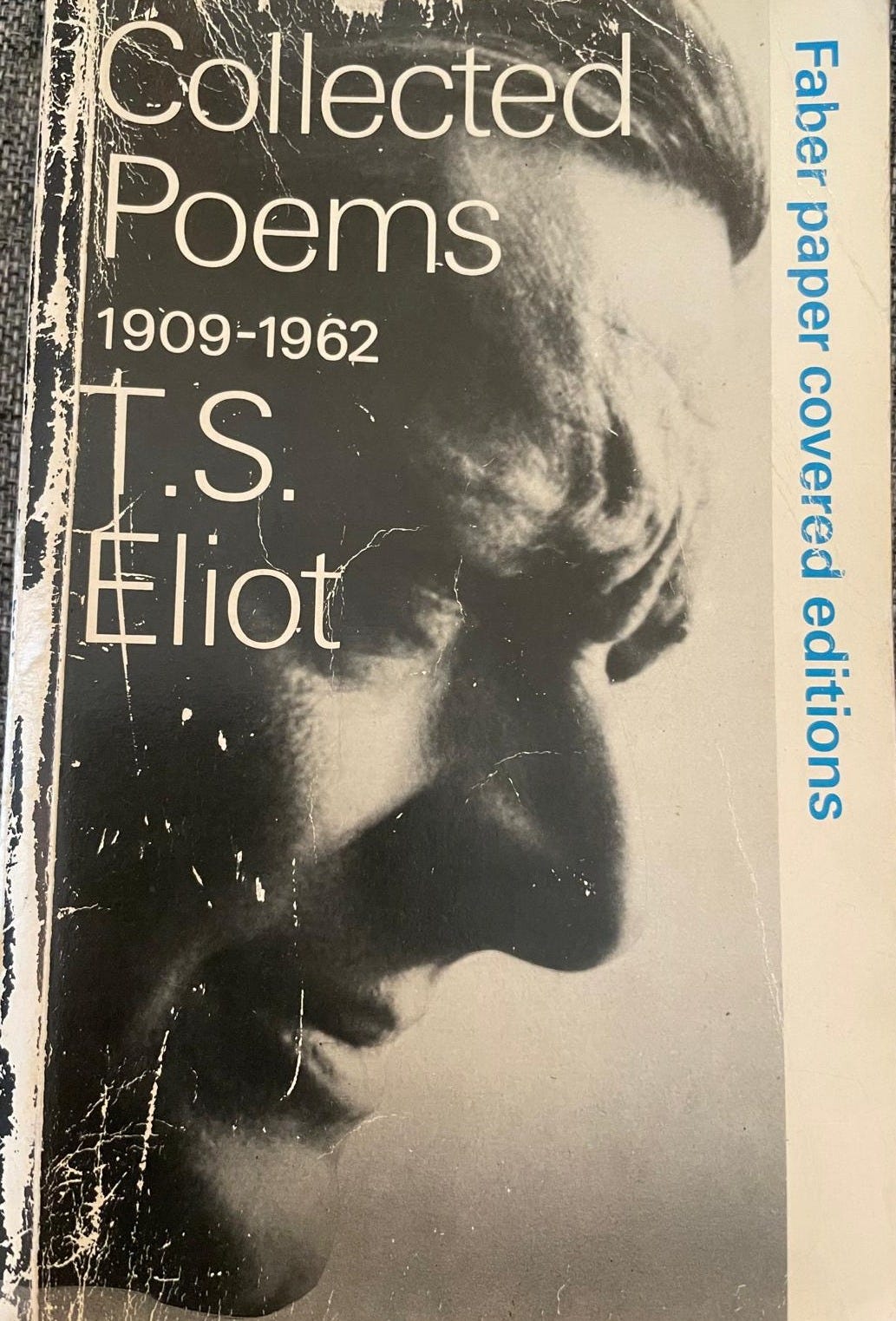
The life and work of TS Eliot is an example of a profound mind successfully struggling to recognise and escape the isolated condition of Modern Man.
Here I explain why you may find his work valuable in understanding how the modern cult of the self limits human life to its limitations.
It is my hope to provide some deep understanding of the state we are in so that you may benefit from the sort of wisdom which is absent from our mass culture today.
I explain why I think Eliot’s life and work are valuable to understanding our current condition here:
Eliot’s first major poem - The Love Song of J Alfred Prufrock - was published in 1917. It describes a young man who becomes painfully aware of a world beyond himself that he cannot access. Paralysed by indecision and the fear of death, he laments the poverty of a life circumscribed by his own limitations.
Almost 20 years later Eliot published Burnt Norton - one of his Four Quartets. This poem shows how Eliot escaped the trap of modernity, presented as liberation, following his conversion to Anglo-Catholicism.
The Eliot of Burnt Norton moves beyond the personal limits of Prufrock to examine the inner and outer life that is realised in the recognition of the incarnation of Christ as the landmark in the history of mankind.
I explain in these videos why this matters - how Eliot examines the nature of our being and of time, echoing Aristotle and presenting a view of mankind in his totality - from the lymph and blood which makes his body, through the inner life of his thoughts and out into the ultimate reality of the world.
This is a world of immediate and then timeless place and purpose, whose magnitude dwarfs the speck of sensation in which Prufrock suffers his predicament.
I hope you find this example of Eliot’s life as useful to yours as it has been to mine.
Part One - Prufrock and Modernity
Here I mention some aspects of Prufrock’s predicament and how this relates to the emerging modern world around him at the time of writing.
Part Two - The meaning of Man in modern mass society: Prufrock’s trap
Part Three - Introduction to the poem “Burnt Norton”
Part Four - The Logos and the loss of God
In this part I show how Eliot’s difficulty is beautifully explanatory. The opening note of the poem is a quote from Heraklitos which shows how the loss of God delivers man into a prison described as liberation and reduces his life to a brief moment bereft of meaning beyond his immediate desires - detaching us from the eternal, and from the objective truth of the reality and nature of being.
Part Five - The Way Up and the Way Down - Two Types of Art and Culture
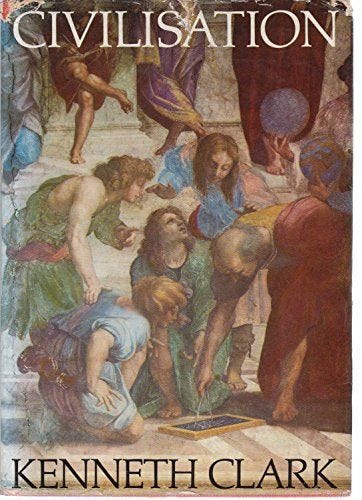
In this part I further explain Eliot’s second quote from Heraklitos showing how it also refers to the two types of art explained by Kenneth Clark in his book, Civilisation.
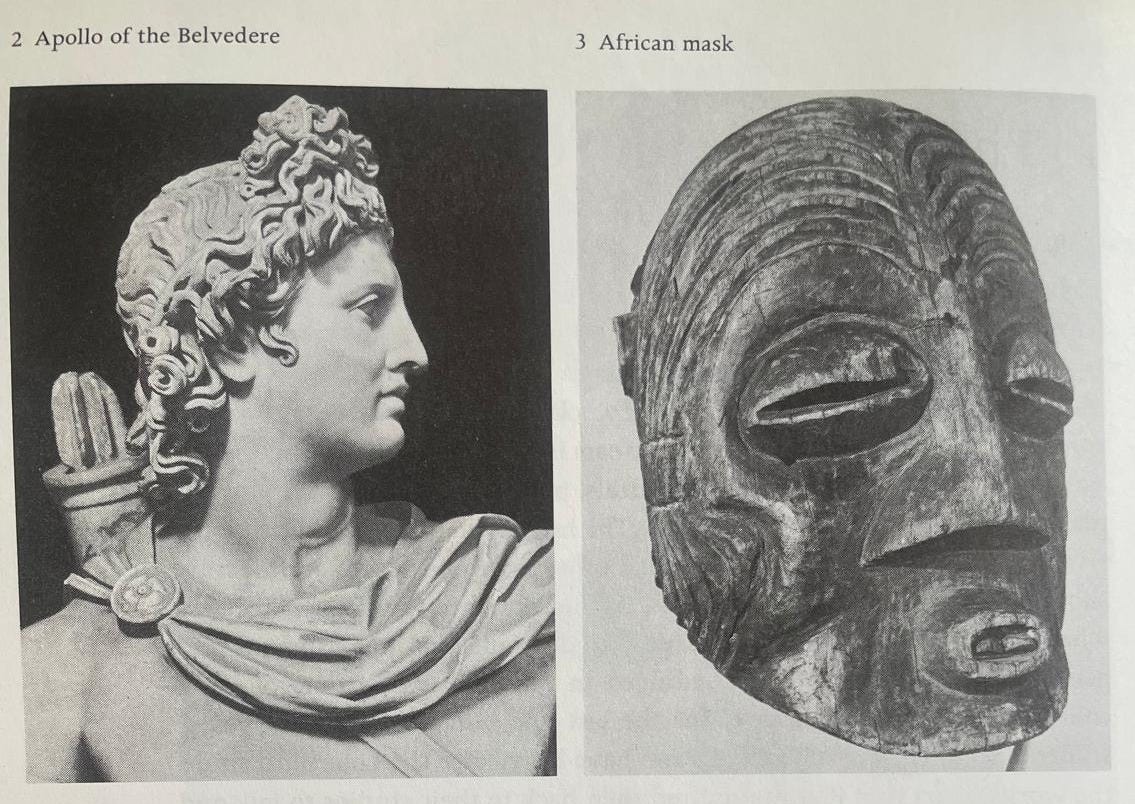
The art of the Apollo of the Belvedere is full of light, and looks upward and outward from Man to a higher spiritual purpose.
The African mask, said Clark, is an art of darkness and of the interior world of man - full of totem and taboo.
The way up and the way down are the same because Man has a choice.
He can reject the world outside himself and substitute its meaning for his own, or he can seek the truth beyond himself. This moves us toward a definition of civilisation versus barbarism. It helps us to recognise the modern condition as a barbarising culture of the self versus the higher spiritual purpose of mankind and the attendant essential value and meaning of his life.
In the next part I read out some parts of Burnt Norton and explain how Eliot’s poem reveals the vast majesty of of being and reality which is denied to us by the fool’s bargain of modern “liberation” into a world only of the Self.
I do apologise for my rather rubbish video editing. It is a relief to me that I managed to do this at all. I shall in time, I hope, get less bad at this.
Please do let me know in the comments if you find this sort of thing helpful.
I will return on Monday with the next instalment on Burnt Norton. Do try to read it over the weekend if you can.
Rather good. More please.
Incredible coincidence! I’ve started to read T. S. Eliot last week He has been on my mind for years now, haunting and badgering me for my ignorance.
His struggle and loneliness might help those suffering souls still on the fence. Sometimes the satisfying vividness of a Chesterton isn’t the best medicine for a recovering hollow man.
Thanks Frank!!!