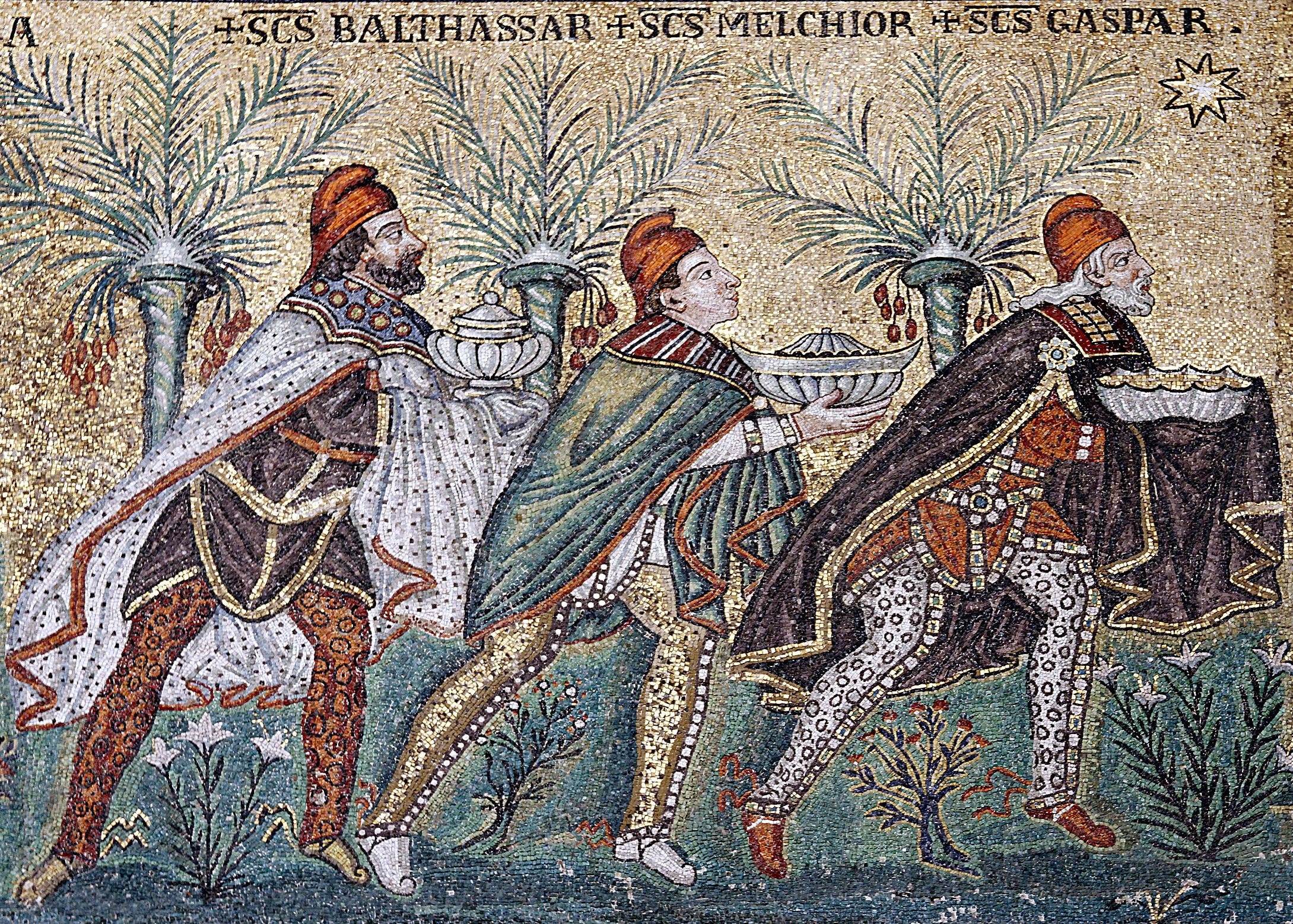
A Poem for Christmas
Journey of the Magi - TS Eliot

In a time when the religion of sentiments seeks to replace that of Christ, here is an unsentimental poem on the impact of Christ on human life.
TS Eliot’s Journey of the Magi is not what we might expect, raised on Star of Wonder and nativity plays at school. At its end is not the glow of what has come but what we know has now gone. The last word is “death”. What is going on?
Journey of the Magi is a poem about the terrible beauty of realising that Christ is real.
It shows what happens to Man when he is transformed by the sight of God.
BEAUTY IS DIFFICULT
Eliot is difficult, and as the only poet of the 20th century who was better than him said,
“beauty is difficult…”
Ezra Pound wrote this line in his Pisan Cantos.
He was going on about Aubrey Beardsley and WB Yeats.

“Beauty is difficult said Beardsley…When Yeats asked him why he drew horrors”.
This line appears in the later Canto LXXX, an echo of the earlier line
“Beauty is difficult”
This simple line appears in Canto LXXIV, which was the first Pisan Canto.
Canto LXXIV discusses the corrupt, usurious mess of the predicament of modern man - and the difficulty of beauty becomes a joke in this dispensation.

Pound was imprisoned when he wrote this canto, situating the difficulty of making beauty appear in a sort of exile. This is a theme we see developed in Journey of the Magi, where the difficulty is not the fashioning of beauty but its realisation.
Yet Pound’s point was not merely that it is hard to craft beauty. In the second instance Pound was also saying that beauty can be difficult to bear: severe, a purgative - a sort of justice without the blindfold1.
This too chimes with the unexpected ending of the Magis’ journey, in which the former terms of life and death have become unrecognisable after the witnessing of Christ.
THE HAZARD OF PERFECTION
We disdain the perfect at times because to approach it is to confront what we aren’t. We prefer to give ourselves to sin rather than to beauty, as sin is easy, it is preferable, and there is always company to be had in it. Self indulgence is a simple impulse, not a difficult question.
There is hazard to men in perfection.
Beauty is difficult because it reminds us of ourselves, and how we stand in relation to it as a synthesis of virtue.
There are degrees of beauty, but they all indicate the absolute, which is God.
That this knowledge presents something present and also beyond us is one reason for the phrase “A terrible beauty”, which in Yeats is born from the beastly, but in Eliot’s sober recognition of the magnitude of the reality of God, is in fact a human response to the numinous made flesh.
The ineffable beauty of Christ, being God made Man, is the most difficult beauty of all. It is here, on earth, which makes it immediate. Christ’s presence defines us as not Him, and our limitations in act and potential are likewise revealed.
We live in an age animated by ghosts in a vast technological machine.
One of these spirits of the time is the false belief that Man has no limits. This is of course only true of God, who must be done away with in order for the modern mind to make sense of itself.
As such, the modern idea of beauty is makeup - make belief about Man, and meretricious belief applied to his face, in order to make him godlike.
The godmanship of modernism is sinking, as our politics and peoples realise that life without the terror of absolute beauty - which is justice - means no beauty at all.
I went up the Scala Santa in Rome last month, which is the staircase Christ trod2. To follow in the footsteps of a great man is one thing, but to consider this was the Son of God makes the experience at times too much.
It is only when I got around that fact that I could really carry on, as the concept in total is unbearable. How can it be that I am here where He was?
It is petrifying to consider.
Eliot’s conversion led to his later expression of Christ as the still point in time3. Christ is the Archimedean Point of Man, making sense of all that came before and after Him.
Without this, there is nothing but what men craft for themselves - a consolation prize, a Christmas only of presents. We can give each other our things and selves, but nothing more.
This is the “old dispensation” described in Journey of the Magi - a world of false idols, both present and past, being made of all that is in man’s gift, alone.
This is a difficult thought, and thinking is also difficult. This is why it is as unpopular in practice as beauty is today. The effects of both are disturbing to our image of ourselves, especially in this case.
The life in Christ is the death of the selfish imago that we cherish and defend against the terrible truth. To some, this is their life’s work - a masterpiece of enslavement, the curation of a mirror image of idealised beauty. The presence of the Ideal Beauty reveals this self-deception.
Though this revelation is a reckoning - of the cost in being and time mis-spent -to see it only as a bargain is a foolish perspective.
The Magi were called the Three Wise Men. What was the price of their wisdom?
Journey of the Magi shows how the knowledge of Christ makes aliens of Men in their own world. Life before and after conversion can never be the same.
Even cradle Catholics know this moment - it comes usually in adult life, when the choice is presented between the mere practice or realisation of faith. It is a moment on the threshold of a most serious step.
It is Good to die to the world, the Devil and the flesh. Beauty is difficult, yes, and its presence in perfection hard to bear. Yet without it in its absolute Man has nothing but himself.
Eliot’s poem has the pleasures of the flesh, the dicing for silver, the arduous journey of life towards its object - and the whispers in men’s ears that to seek God is pure folly. At the end is the bitter agony of kings, realising their limit and those of the lives around them.
At its centre faith in Christ destroys the image of the world we had before, a life of empty wineskins kicked about, a gamble in soon-spent pleasures.
Christmas reminds us that life is not a death sentence, but a phrase to be pronounced in praise or blame.
In Journey of the Magi, Eliot speaks to the depths of the power of Christ’s incarnation as a Man.
His strange poem is an attempt to reconcile Man with the knowledge of the Divine in a fallen world of ever more sophisticated misprisions.
This is no mere story, it is a journey to the heart of human darkness. Lit by the light that never goes out, it shows us what we are and all there is - with and without the knowledge of the Salvator Mundi.
I hope you enjoyed this unusual and somewhat difficult spot of condign beauty, it being Christmastime.
Should you think your friends deserving of the vexatious majesty of TS Eliot, you could consider doing this:
I hope you all have a blessed Christmas. I shall be back in the New Year with more on Pascendi, on TS Eliot, and on the parlous state of our machine culture.
If you are a difficult beauty appreciator you may sponsor my work here:
Beauty was not only aesthetics to Aristotle, who considered its ethical dimension in relation to the true and the just. Consider the English word “fair”, which means “beautiful” and/or “just”. Beauty is no mere spectacle, and neither a matter of taste nor the preference of perspective. To Aristotle it is the summit of virtue, in which all good things resolve in a form approaching perfection.
Journey of the Magi is a story of man’s approach to perfection - and what it does to his idea of himself and the world.
You go up on your knees. The staircase is covered by wood, but there are glazed portholes through which you can still see the blood of Christ on the steps.
It was hard to do this, and not because of the pain in my knees. The weight of the moment is awful.
For more on this, see James Matthew Wilson’s excellent T. S. Eliot’s Still Point.


Thanks for this, Frank. I like that Eliot poem, but haven't read it in quite awhile. I like this line from Flannery O'Connor's story, "A Good Man is Hard to Find":
“She would of been a good woman,” The Misfit said, “if it had been somebody there to shoot her every minute of her life.”
Have a very Merry Christmas!
Beautiful, thank you.