

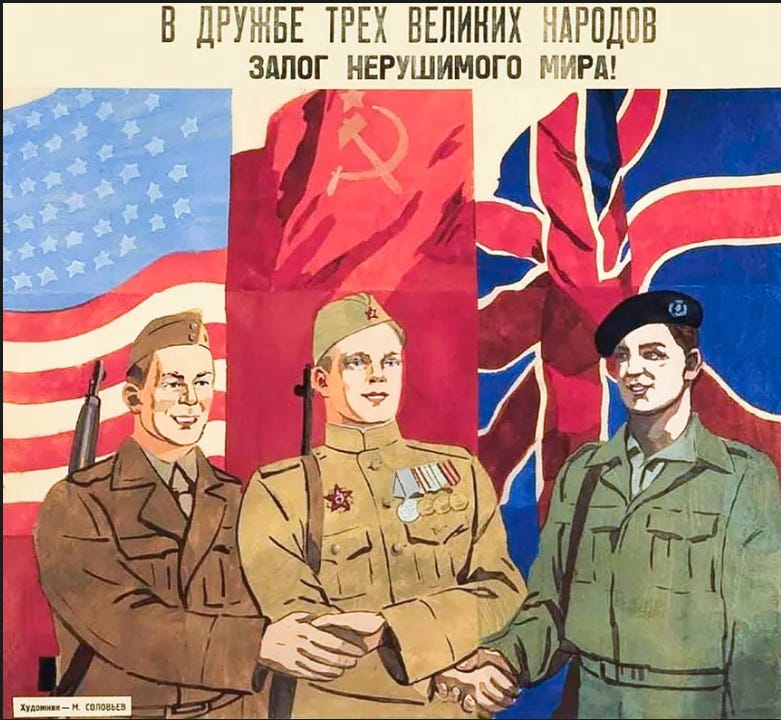
In this post I will offer some analysis of foreign affairs and the state we are in today.
I say the major war with Russia is unlikely due to practical constraints (though not impossible).
I add some remarks about the distance between the ruling establishment and the ruled, and end with a cautionary tale about the millions of children made homeless by the parallel revolution to Liberalism of the Bolsheviks.
CONTENTS
War in Europe?
Mind The Gap (between the rulers and the ruled)
Rebalancing - a realist concept for a return to sanity
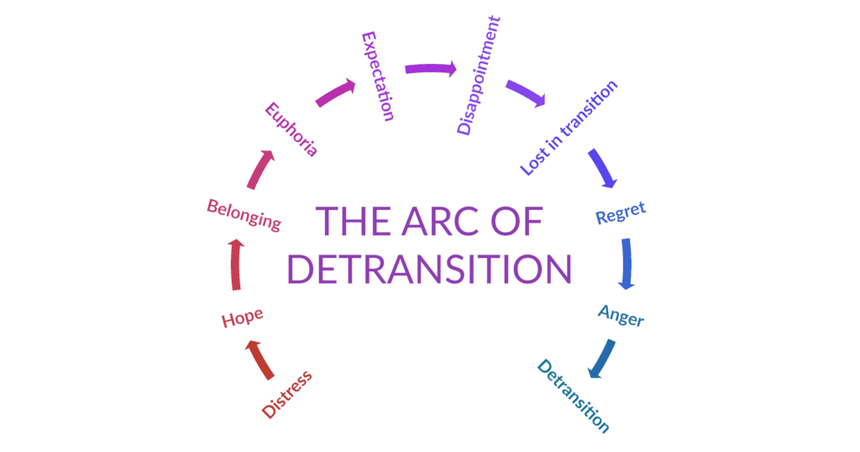
Dependency culture - a painful detransition?
The Limit and the Lesson - the orphaned children of the revolution
WAR IN EUROPE?
In brief
War with Russia is being talked up in Britain and in Europe despite the fact that it seems impossible to fight or much less win one due to:
Low armament stockpiles
Limited manufacturing capability
Supply chain problems
Financial constraints
General lack of war-readiness
10 year timescale to build a capable counterforce
US disengagement from European security
Popular discontent with domestic European governments
The strategy of the pro-war faction (UK, EU) appears to be to designate Russia as the perpetual enemy, and to provoke the Russians into a response which is sufficient to trigger direct US entry into a war.
In depth
Since the publication of Dr Maitra’s “Dormant NATO” paper in late 2023, the US has moved to “shift the burden” of European security guarantees to the Europeans. That is to say, to “draw down” US commitments to NATO in Europe.
The US drawdown from donating money and weapons to Ukraine has seen the Europeans make good the difference - a 67% rise in European-funded military aid to Ukraine in 2025 (for example).
This means Europe - that is, the EU and Britain - must maintain a far higher level of spending on the Ukraine war than (say) in 2023, and also find the money to rearm and rebuild its own armed forces.

Decades of reliance on the US security umbrella has seen European armies dwindle since the end of the Soviet Union.
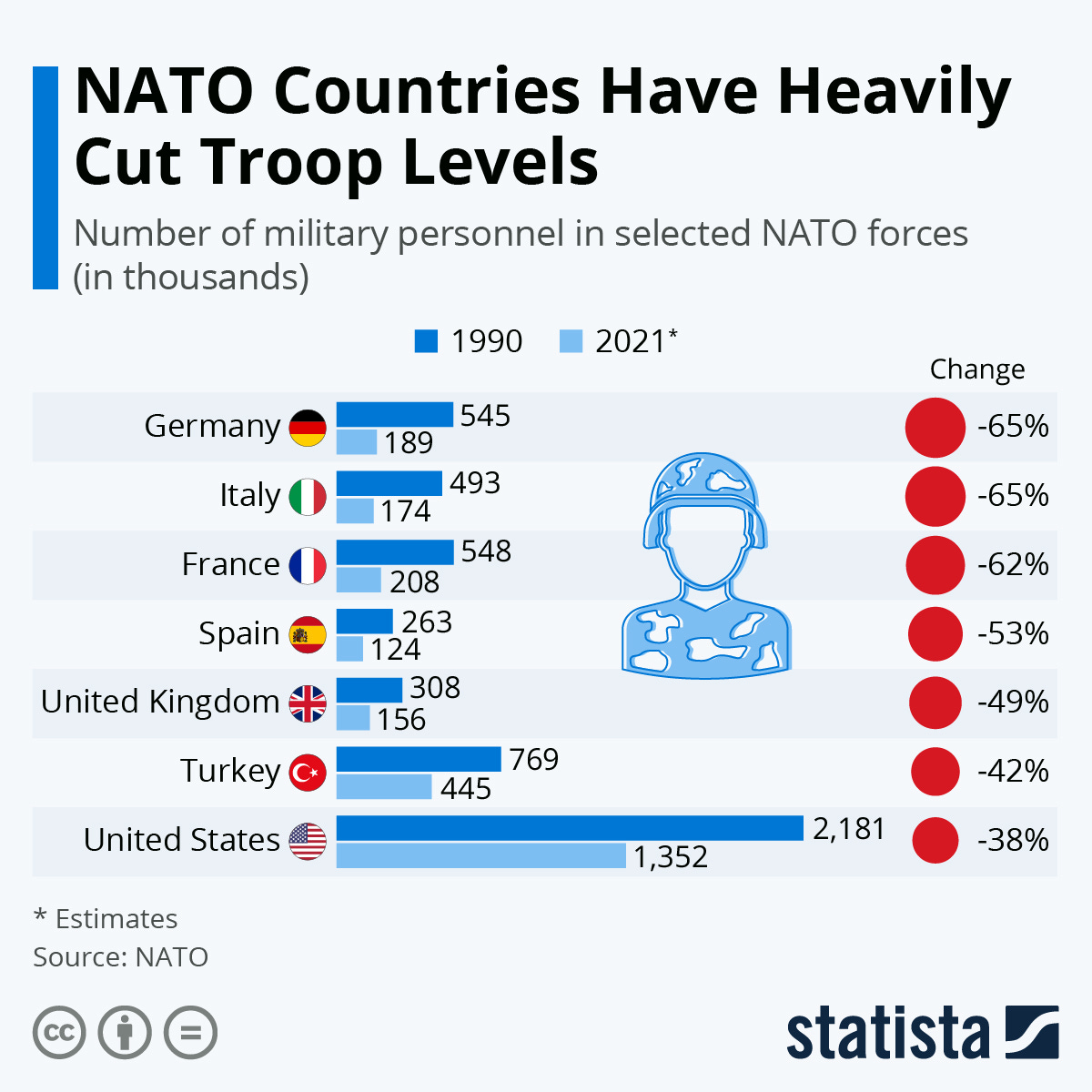
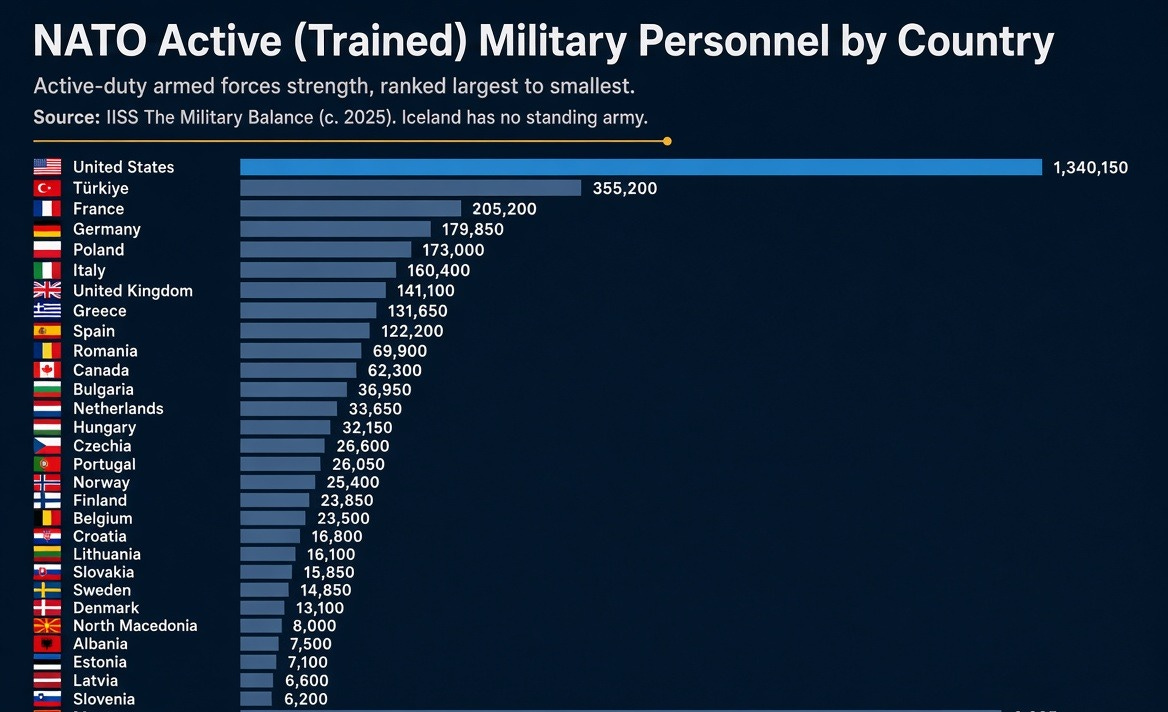
Turkey has the second largest armed forces in NATO.
For decades the ruling establishment has inflicted policies on its populations which amount to a series of outrages.
Political decisions which result in the corruption of children and criminalisation of the innocent combined with the refusal to punish criminals means the Liberal State is in fact a partner in crime.
Clamouring for a war is simply an escalation of this modus operandi, for which even anarcho-tyranny is a generous term.
MIND THE GAP
The mind gap between ruler and ruled is obvious to us and not so obvious to them. The rulers appear to inhabit a bubble which has burst for the rest of us, preserving them from the awful reality created by decades of destruction, corruption, propaganda and managed decline.
Examples of the bubble:
USG narrative of the Iran war (success versus disaster without current limit)
Rhetoric of war with Russia versus capability to fight one
Public disaffection with government action and inaction
“The enemy is at home” versus “the enemy is abroad”
Continued support of failed grand strategies against public opinion
Elite luxury beliefs versus declining standards of living for the many
That awful reality has become our new normal. It is seldom honestly represented in the mass media, which is of course largely an engine of state propaganda.
The Iran war, combined with the effects of the Ukraine war, has unleashed an expanding disaster whose limits are not currently set. The economic problems are now structural, meaning food and fuel inflation (and scarcity) will very likely continue throughout the next year at least.


How many Britons, Germans, French would fight to defend the politics of national suicide?
How many of them are actually British, German and French?
The native populations of the West are largely demonised, censored and overtaxed by governments managing their lives into a deepening crisis. The non-native populations are hardly united by patriotic fervour.
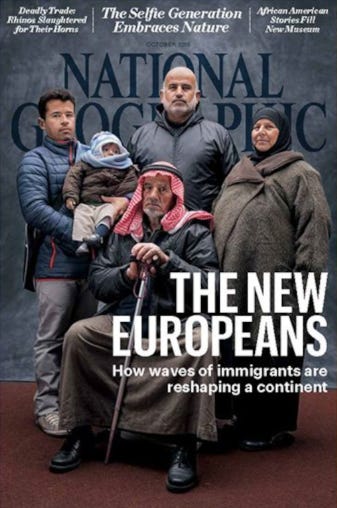
If they declared war how many people would turn up?
The war rhetoric is completely disconnected from this reality, as it is from the fact there is neither the industrial nor military capacity to fight.
What we sense today is a mindless gap between how we experience the world and how they represent it. The gulf between the political class and the electorate is getting wider. The world they describe does not match the world their policies have shaped. The capabilities they confidently boast do not correspond to actual capacity. It is a world of make belief which the world itself makes us disbelieve.
This matters not just because this makes governance unstable.
It is significant because the manufacture of the sense of reality through mass communication is the foundational political technique of the 20th century.
This is not working any more. This means the elaborate and constantly refined machinery of human management known as “liberal democracy” is intact, but can no longer deliver conformity and compliance.
What will replace it in the short term does not look like a swift return to order. The ruling order in the West is clearly unstable structurally and ideologically.
Its decisions have been marked by a devotion to ideology over practical reality, resulting in the contradiction of reality with rhetoric which we see in the headlines.
REBALANCING
In international relations there is a school of thought called realism. Some of its pupils write foreign policy for the US government today.
Though this faction of sanity is not the most prominent at present it does offer much hope for a restoration of order in the medium term.
One concept offered by the realists (and neorealists) is “rebalancing”.
To suggest this in geopolitics is naturally to accept the minatory fact that the time is out of joint - that things are not balanced at present.
This in turn implies a sense of order that has been violated.
I think all these things true enough to explain what is wrong and how to put them right.
Rebalancing is a very helpful concept as it is non-partisan, expresses the injustice and instability of the moment in a neutral fashion graspable by all, and promises a practical way out of the mess.
It broadly seeks recognition and reconciliation through trade and relations to mitigate conditions producing armed conflict.
Construction, not destruction. Gestation, not migration.
Rebalancing is a healthy motto for a sensible future foreign (and domestic) policy platform. Nationally and internationally our affairs are out of kilter. International actions are undermining the national interest.
These international affairs drive food and fuel inflation, magnify demographic replacement and further polarise our frayed societies into antagonistic factions of for and against a political economy which does its terrible business as usual regardless of elections.
The system as is replaces the common good with universal evils.
It is morally nihilistic, meaning it sees no value nor purpose to life beyond the supply of demands for the satisfaction of desires. What is more, even these consumer aspirations are increasingly difficult to satisfy as the way we are ruled appears to be breaking our economy.
This fatal error on a grand scale has also severely undermined the basic unit of the nation and of culture, which is the family. An economy which reverses this is obviously urgently required to preserve us from total disintegration.
DEPENDENCY CULTURE
A sort of dependency culture has taken root at state and street level.
At the level of the elite, the ruling establishment are dependent on the patronage provided by the economic and influence machinery of a grand strategy which has collapsed. We are ruled by people whose careers rely on the output of a broken machine which is in fact breaking everything else.
The US grand strategy for the 1990s and beyond was an attempt to secure a standardised world under the leadership of the Americans, with its debt-consumer system secured by military supremacy and a liberalising cultural apparatus at home and abroad.
This utopia has not materialised, the world has fractured into great, emerging and declining powers, and the moment is uncertain. The new international order has not yet been born, though the old has certainly expired.
That it is not the 90s anymore is one way of seeing this wedding to a dead end.
Another dimension of the dependency created by the liberal-international political economy is that of direct and indirect dependence on government spending - secured of course by ever rising borrowing.
A further is the dependence on State-sanctioned explanations for the world as it is and should be.
Both of these addiction economies - of subsistence and of the supply of meaning - are bankrupt. This means they cannot continue to answer the needs of the people who rely on their supply.
The supply chain of this addiction economy has been cut by its own designs.
The beliefs it supplies contradict experience, the costs of an ever-expanding administrative state cannot be met, the financing of domestic “colour revolution” propaganda and NGOs is increasing impossible, and so on.
When addicts are deprived of their supply they do not instantly become reasonable.
A difficult period of detransition lies ahead.
THE LIMIT AND THE LESSON
In short, this is a system which refused to recognise the hard limits of reality.
Always a project of irrealism, the Whiggish progressive project has resulted in revolutionary chaos with neither direction nor solution from within the unrecognised limits of its own operating system.
We are the homeless children of this revolution.
In the 1920s - as “liberal democracy” was being installed in the West, a term was applied in Russia to those orphaned by Bolshevism.
It was bezprizorniki - “Those who are uncared for”.
It described the millions of unattended (or neglected) children in the streets. Their parents were dead, disabled or had discarded them due to poverty. War, hunger, migration and disease abandoned millions into a feral life of predatory crime.
The future of the nation had become a menace to a society which had shattered the family.
The result was misery, the moral and sexual corruption of children, their death by violence, cold and disease. The State sought any solution within its means to “liquidate” the parentless millions it had fostered into a feral life.
This was the result under a strong, centralised governing power whereas our system is disintegrating. There are benefits (as well as social costs) to the removal by bankruptcy of State benefits which include the support of millions made homeless by the criminal business of mass migration.
There is commonly no place like home for anyone these days, and that is a product of our economic policy.
A future politics can be built from the general recognition that we have been abused by our leadership. The recognition that the crisis we inhabit is not unique in the fact that it reduces to a choice between better and worse, good or evil. This happens at times of change, and we live in one now.
The depth of the crisis is the necessary permission required to correct it.
An emerging consensus towards the restoration of sanity, of human dignity and balance to the management of human affairs is behind the rejection of liberal globalism in the West. If the wars do not consume us all it is likely that the world thereafter will be changed, changed utterly.
How much terror and how much beauty will be born remains to be seen.
If you would like to detransition your friends with rebalancing sanity you could consider doing this:
If you would like to encourage this sort of thing you can also do this:
I am sleeping normally again and so will be back (God willing) on Friday.
Ideas! What a feast. Thankyou
I see no reason whatsoever why Britain should go to war with Russia. I see no reason whatsoever why the British people should risk their lives to defend Ukraine. I see no reason whatsoever why the young men of Britain should sign up to fight for a country that apparently hates them.
Trusting in God though, things aren't falling apart, they're falling into place.