

The spiritual and intellectual poverty of our times is so profound that it often passes without notice.
It has been normalised by constant subtraction, leaving generations unaware of what has been lost, or even that there has been a loss at all.
This is an essay about what that means for our civilisation.
Whether we can reverse the rot which threatens to replace it with barbarism is a matter of recognition, then remembering, and finally of restoration.
It will take you about ten minutes to read.
I include some references to some books you might find useful.
CONTENTS
Is our civilisation being destroyed?
Why civilisations die
Culture and Civilisation
Recognising the rot
A Rootless Cosmopolity
What is meant by “restoration”
What is the rot?
Remoralisation
Is our civilisation being destroyed?
Towards the end of his 13 part television series “Civilisation”, Kenneth Clark said civilisation is fragile and is always threatened by barbarism. It cannot be taken for granted and can be destroyed. At times, it is.
Do we live in such a time?
Clark listed the enemies of civilisation, which he said were:
“…first of all fear — fear of war, fear of invasion, fear of plague and famine, that make it simply not worthwhile constructing things, or planting trees or even planning next year’s crops.”
We have suffered a fearful plague under the Covid regime, and the threat of war is escalating. Today, few people are possessed of the optimism common a generation ago. Unbelief in the future is a sign that civilisation is endangered.
Another omen was noted by Clark - the fear of speaking out, which he described as the “fear of the supernatural”:
“…which means that you daren’t question anything or change anything.”
In what remains of Western civilisation there are penalties attached for questioning the ruling belief system.
Why civilisations die
The threat of a social or even financial death sentence for public heresy against the State religion further threatens the material prosperity, shared order and belief in the future which Clark says are all necessary for civilisation to survive.
When people no longer believe in the future the horizon of life shrinks to the self. Civilisation takes place on a far longer timescale. It is secured by its capability to endure, and as Clark says it is rotted by “cynicism and disillusionment” leading to the “destruction, fear and loss of creative confidence” which typifies barbarism.
Clark shows us that civilisation can be annihilated by demoralisation as well as by war. When man’s world shrivels to the limits of himself he becomes like an atom in a gas, a particle sublimated from something once solid. You can call this process of aimless atomisation liberating, and that is in fact what our mass culture does today.
Culture and Civilisation
We must not mistake what is for what was, nor for what can be. What we understand as culture today is in fact a replacement for cultural life and its origins, which are found in the family.
When we say the rights of family are prior to those of the State we are noting a fact whose consequences are not immediately visible.
The family predates the State - of course. Yet it also produces what makes life worth living, which is how TS Eliot once described culture.
The relationship of culture to civilisation is so close that the two are often used interchangeably. This shows us how important it is to understand what threatens our civilisation and what has replaced the culture it produced.
Of course, one reason why this is in turn significant is that our lives will be less worth living if the rot continues without reversal.
Recognising the rot
Culture cannot be remade by policy, but policies can be reversed and enacted which do not actively deracinate it.
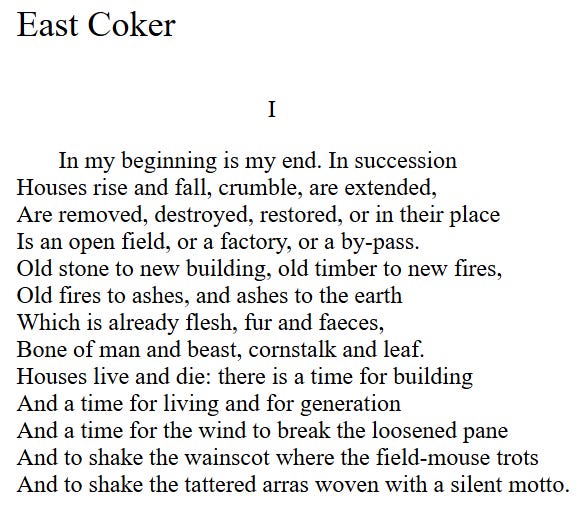
The loam in which it flourishes can be watered instead of salted, bringing new life from the “flesh, fur and faeces” of our heritage.
The problem of the defence of civilisation is related to a misprision of historical causes, which Herbert Butterfield points out.
In “The Whig Interpretation of History” Butterfield shows how the progressive sages of our times judge the past from their momentary point of view - as if all human action inexorably progressed to produce themselves and their idea of the world, our purpose and its moral order.

The mistake being made is to see the past as a sort of hypotenuse, an upward slope of causes producing the effect of progress. This is the reasoning for permanent revolution. It is the foundation of all policies of replacing order with chaos, meaning with its opposite, and the value of life with price.
I have described this “progress” as precisely the sort of destruction which terminates a civilisation. It reduces the human condition to the absurd - to disharmony with the Natural law, rights and order. The result is moral collapse and social disorder resulting from the complete undermining of the recognition of objective reality, truth and morality1.
The zelotic belief that this terminus will be a sort of utopia inspires this recasting of the past from the present point in time, which in turn justifies everything that has been done towards an as yet unrealised and idealised future.
We must awaken from this delusion to fully understand the threat to our civilisation. This progressive belief system has produced a cult to replace our culture, which reduces all life to consumer sensations animated and advertised by the mobilisation of desire.
What we have in place of culture today is a symbol set transmitted by mass communication and infused with nihilistic fervour.
In this simulacrum of being and reality there is nothing more than wants. Demand is supplied for only what the product line of our political economy can offer. There is nothing more to life than what is presented, and there is no sin but the restriction of human action.
This is a license to universal barbarism, which is openly practised at the level of self and of the State.
This post is paywalled in recognition of those subscribers who support my work.
If you would like to read my work but cannot pay, email me a brief note titled SKINT at frankwrighter@pm.me and I shall admit you free of charge.
